Semi-Annual Doggie Doo Rant
Every couple of years, we find it helpful to remind everyone of the Golden Rule of Doggie Decency here at The Capes: If YOUR Dog Poops It, YOU Should Scoop It. (Do you like that? I made it up myself.) We have received reports of some uncollected doggie doo recently on the gravel path that connects Fall Creek Drive to the Cottages. Here are just a few of the reasons why a dog owner should ALWAYS clean up after their dog:
- Not cleaning up after your pet is a CC&R violation and could lead to fines…or worse! Section 6.4 of our CC&Rs states that pets must be reasonably controlled so as not to be a nuisance. “Any inconvenience, damage or unpleasantness caused by such pets shall be the responsibility of the respective owners thereof. No dog or cat shall be permitted to roam the Property unattended, and all dogs and cats must be kept on a leash while outside a Lot. An owner or resident may be required to remove a pet upon receipt of the third notice in writing from the Board of Directors of violations of any rule, regulation or restriction governing pets within the Property.” These biological booby traps definitely qualify as “unpleasantness” and if your dog is proven to continually leave piles of unpleasantness around the neighborhood that are not picked up, you could potentially be asked to remove HIM from the property.
- It’s unhealthy. Dog feces can contain several very common diseases that can be transmitted to people, cats or other dogs – giardia, roundworms, salmonella, and Ecoli, to name a few. Additionally, your dog can spread or contract parvovirus or coronavirus (no, not the COVID-19 coronavirus!) through infected feces.
- It’s not good for the environment. Doggie doo is toxic to your lawn, causing burns and unsightly discoloring. As it decays, it can even create nutrients for weeds and algae to thrive. If you introduce enough waste into the waterways, the then thriving weeds and algae can overtake the water, and limit the amount of light that can penetrate the water’s surface. As a result, oxygen levels in the water decrease, asphyxiating the fish that live there.
- It’s just gross. It looks bad, it smells bad, and let’s face it – the only thing worse than stepping in your own dog’s yard raisin is stepping in it when you don’t even own a dog.
Be courteous to your neighbors, the environment and even to yourself, and clean up after your dog. If you have guests staying in your home when you are not with them, remind them of this rule as well. Doggy deposits belong in the trash, not on our trails, lawns, or beach paths. A quick scoop keeps The Capes beautiful and everyone’s shoes considerably happier!
News from the Landscape Committee…
Fire Season and Fire-Resistant Plants
Summer is here, with longer days and warmer weather. This is also the beginning of fire season across the state. Homeowners are encouraged to think about ways to protect their homes and property. Information for homeowners can help to prepare for fire season at the coast. This can include information from Fire Interagency Fire Center; https://www.nifc.gov/fire-information/fire-prevention-education-mitigation/wildfire-mitigation/home . This site provides information compiled from multiple agencies to give homeowners information for preparation of property during fire season.
If you would like to schedule a free meeting with a local fire marshal to obtain information on how to improve the fire safety of your home and yard, please contact the LSC for more information. (landscape@thecapeshoa.org)
One way to help protect your home is to consider utilizing fire-resistant plants in your landscaping plan. The Landscape committee has researched some plants considered to be fire resistant to add to the LSC suggested plant list. These come from a document published by Oregon State University. This document has been peer reviewed! It gives helpful information regarding fire safety and landscape design.
Here are 5 plants you might consider for your next planting.
1- Shrubby cinquefoil
Dasiphora fruticosa
Formerly known as Potentilla fruticosa, this hardy, bushy shrub with small grayish-green leaves produces flowers all summer long in shades of yellow, gold, white, pink, red and orange. Cultivars include ‘Abbotswood’, ‘Gold Drop’, ‘Goldfinger’, ‘Tangerine’ and many others.
- Low water use
- Full sun
- Attractive to butterflies, bees and other pollinators
- Deer-resistant
- Height: 2–4 feet
- Spread: 2–4 feet
- USDA hardiness zone: 2–7
2- Iceplant
Delosperma species
Not to be confused with Carpobrotus edulis (also called Iceplant), which is known to be invasive. Low growing with succulent, green foliage that changes to reddish-bronze in winter. Not suitable for areas with long-term snow cover. Yellow ice plant is one of the most cold-hardy ice plants. Cultivars and varieties include D. cooperi (Purple iceplant), ‘Lavender Ice’ and ‘Mesa Verde®’, among many others. Great for rock gardens.
- Low water use
- Full sun to partial shade
- Attractive to pollinators
- Height: 1–3 inches
- Spread: 24–30 inches
- USDA hardiness zones: 4–10
- Flowers: multiple colors
- Bloom time: June–September
3- False indigo
Baptisia hybrid
Not to be confused with Amorpha fruticosa (false indigo bush), which is known to be invasive. A long-lived perennial with pealike flowers, a rounded growth habit (more shrublike) and interesting foliage. Used to make dye. Do not overwater. Host plant for the larvae of some butterfly species. Cultivars with blue, white or yellow flowers.
- Low water use
- Full sun
- Attractive to bees, butterflies and other pollinators
- Deer-resistant
- Height: 3–4 feet / spread: 3–4 feet
- USDA hardiness zones: 3–9
- Flowers: dark blue, yellow, white
- Bloom time: May–June
4- Blanket flower
Gaillardia varieties
Grayish-green foliage and daisylike flowers in various colors. Very drought tolerant. May be short-lived. Long-blooming perennial; keep deadheaded for continuous bloom. Fuzzy, round seedheads follow flowering.
- Low water use
- Full sun
- Attractive to butterflies
- Deer-resistant
- Native species or cultivars available
- Height: 8–36 inches
- Spread: 12–24 inches
- USDA hardiness zones: 3–10
- Flowers: red petals tipped in gold, all gold or burgundy, with reddish-brown centers
- Bloom time: June–September
5- Serviceberry
Amelanchier species
A multi-stemmed shrub or tree that bears white flowers in spring followed by edible, purplish-black fruit that can be used in jams or wine. Excellent fall colors of red-orange. A. alnifolia (Saskatoon serviceberry) is the native species. Cultivated species include ‘Regent’, which is more compact.
- Low water use
- Full sun to partial shade
- Attractive to butterflies and birds
- Native species or cultivars available
- Height: 6–10 feet
- Spread: 5–12 feet
- USDA hardiness zones: 3–10
- Flowers: white
- Bloom time: March–April
Some of these cultivars can be found at Cistus Nursery who also have a very knowledgeable staff.
Here is a great article on “candling” conifers.
https://oregoncoastgardener.blogspot.com/2011/05/candling-pines.html?m=1
Keep an Eye Out for Cucumber Vine
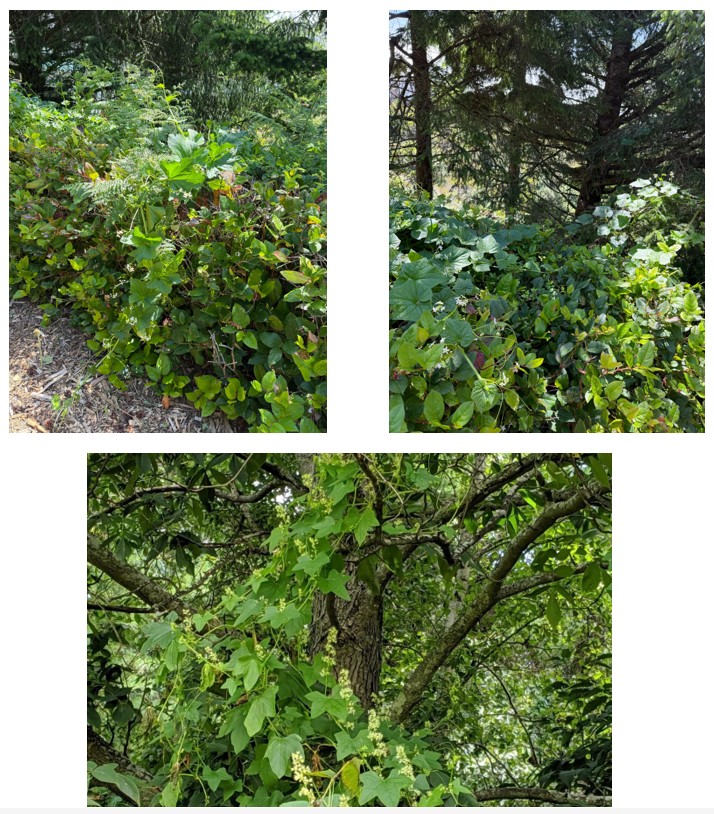
Wild cucumber vine (Echinocystis lobata),despite its familiar name, is generally considered a weed due to its aggressive growth. While elusive in early spring, growing among bushes and ground vegetation, this fast growing warm season annual has branching vines that, if left unchecked, can grow to over 25 feet, smothering other plants and trees by attaching itself to its hosts with its strong tendrils. By mid summer, the vines produce white flowers that develop into green spiny fruit, somewhat resembling small garden variety cucumbers, but are not edible.
This invasive plant is easily controlled by pulling out the young vines, preferably before the vines begin to flower and fruit, as it easily self-seeds.
Photos taken along Capes Drive illustrate the cucumber vine’s progressive, invasive growth.